
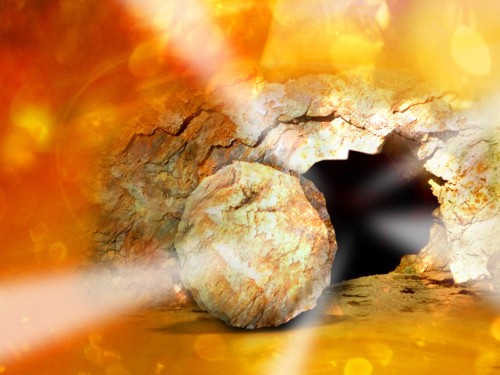
The death and resurrection of Christ reach far deeper than the idea of a supernatural miracle in which Jesus physically rose from the dead.
What becomes visible here is a completely natural miracle—a reality that unfolded in the life of Jesus of Nazareth, a man of flesh and blood. Precisely for that reason, it opens the way for us to experience the same resurrection: not as something outside of us, but as the living reality of Christ in us.
Death and Resurrection as an Inner Reality
Whenever Paul speaks of death and life, of dying and resurrection, he is almost always referring to a spiritual reality. Death points to a darkened consciousness; resurrection to the breaking forth of the Light of Christ within us—the new birth.
“We were therefore buried with Him through baptism into death… in order that… we too may walk in newness of life.” (Romans 6:4,11)
“Set your minds on things above… for you have died, and your life is hidden with Christ in God.” (Colossians 3:2,3)
“I have been crucified with Christ; and it is no longer I who live, but Christ lives in me.” (Galatians 2:19,20)
“…although you were dead…” (Ephesians 2:1)
“…made us alive together… and raised us up together…” (Ephesians 2:5,6)
These words do not speak of physical death, but of an inner transition: from darkness to Light, from the old consciousness to participation in the Christ-Life, from walking according to the flesh to living in the Spirit.
“…because we look not at the things which are seen, but at the things which are unseen… for the things which are seen are temporary, but the things which are unseen are eternal.” (2 Corinthians 4:18; incidentally, Paul did not teach dualistic Gnosticism.)
If this is the heart of the gospel of Christ [1], why should we make an outward, bodily resurrection the central message?
[1] Romans 15:19; 1 Corinthians 9:12; 2 Corinthians 2:12, 4:4, 9:13, 10:14; Galatians 1:7; Philippians 1:27; 1 Thessalonians 3:2
The True Revelation of the Gospel
The gospel of Christ does not reveal an event outside of us, but a reality within us: the transition from spiritual death to Life.
“The gospel of the glory of Christ, who is the image of God.” (2 Corinthians 4:4)
It is about Christ, who is all in all—first becoming visible within our consciousness.
What Happened at Golgotha?
At Golgotha we see Jesus in his deepest humiliation. His body was broken, his strength exhausted. The Light that had once shone so brightly seemed to be extinguished.
He did not cling to his “equality with God,” but humbled himself. In his consciousness he found himself in outer darkness—that which we call “hell”: a state in which all awareness of unity with God seems to have disappeared.
In that condition of utter abandonment, the cry is heard:
“My God, my God, why have You forsaken me?“
This is the experience of total inner darkness. Not because Christ actually disappeared, but because the consciousness of Jesus had become darkened. Spiritually speaking, this was “death”: the experience that all awareness of unity with God seemed to have vanished.
Between the Cross and the Resurrection: What Really Happened?
After approximately six hours—exceptionally brief for a crucifixion—Jesus was taken down from the cross and laid in a tomb. Remarkable details in the Gospel account raise questions.
The linen cloths lay in the tomb, but the face cloth had been folded separately. Why?
A huge quantity of myrrh and aloes was used—about thirty kilograms. An excessive amount for embalming, yet well known as a remedy for treating wounds and relieving pain.
After three days, the women returned to the tomb to anoint the body again. Why again, if this had already been done? On the way, they wondered who would roll away the stone. Why ask that question if the tomb was meant to remain sealed?
In the story of Lazarus, the women wanted to prevent the tomb from being opened after three days because of the smell of decomposition. Why not here?
These details raise the question: was Jesus perhaps still alive, and were the women going to the tomb to care for him?
Resurrection as Metamorphosis
In the period between Jesus being laid in the tomb and the visit of the women, the deepest miracle takes place. The resurrection power of Christ breaks through in the body of Jesus—not as an external intervention, but as an inner breakthrough of the Christ-Life in the midst of death.
His battered, exhausted body undergoes a transformation—a metamorphosis into a glorified body. This is the revelation of the resurrection: Christ becoming visible through the very limits of human vulnerability.
The essential miracle of Easter is the revelation of the resurrection power of Christ, regardless of how one understands the events surrounding the physical death of Jesus. It is not a supernatural interruption of nature, but the revelation of a deeper reality within nature itself.
Whether Jesus physically died or not is not the essential point. By focusing on a bodily resurrection as a supernatural miracle, we miss the essential point: the resurrection power of Christ that is present in everything and everyone.
Resurrection as a Universal Reality
What became visible in Jesus is not an exception, but a revelation.
If such a transformation was possible in his body—in that extreme condition—then it is possible for every human being to undergo such a transformation, regardless of our present condition.
Indeed, this possibility is embedded within the whole creation: the transition to a new heaven and a new earth, here and now. The resurrection power of Christ is not exclusive, but universally present—in you, in me, and throughout the whole creation.
“If the Spirit of Him… dwells in you, He… will also give life to your mortal bodies through His Spirit who dwells in you.” (Romans 8:11)
“For this perishable must put on the imperishable, and this mortal must put on immortality.” (1 Corinthians 15:54)
It is not about dead bodies, but about mortality being permeated by Life—here and now.
Christ in Us: The Hope of Glory
The last Adam—Christ in us—is a life-giving Spirit. In Him lies the power of transformation, regardless of the condition of our consciousness.
“…He will transform our lowly body so that it will be conformed to His glorious body…” (Philippians 3:21)
This transformation does not begin at or after death, but at awakening. Wherever the Light of Christ dawns within us, renewal begins.
The Victory Over Death
Jesus conquered death—not simply by returning from physical death, but by fully facing the darkness and trusting the Christ-Life within him.
Christ in us is therefore the hope of glory—not only after death, but here and now.
“You will not abandon my soul to the realm of the dead…” (Psalm 16:9–11)
“Everyone who lives and believes in Me shall never die. Do you believe this?” (John 11:26)
This speaks first and foremost of spiritual life: a state of consciousness in which physical death no longer has resonance or power.
The First Resurrection and the End of Death
When this life breaks through, physical death also loses its grip. The body is no longer defined by mortality, but by the Christ-Life at work within it.
“Blessed and holy is the one who shares in the first resurrection… over such the second death has no power.” (Revelation 20:6)
“Death, where is your victory?” (1 Corinthians 15:55)
The sting of death lies in sin—missing the mark—living from separation and the law that arises from the knowledge of good and evil. But wherever the consciousness of oneness is found, death loses its power.
From Darkness to Light
What we have experienced as separation turns out to be the result of a darkened consciousness. In reality, there has always been unity between God and humanity.
Jesus has gone before us in this—not to accomplish something outside of us, but to reveal what longs to awaken within us. He is the firstfruits. Humanity—and ultimately the whole creation—will follow.
The way from death to Life is the way from darkness to Light. It is the path on which Christ becomes visible within us.
Where Christ becomes visible within us, Life breaks through. There death loses its power. There creation is renewed—from the inside out.
Reflection Questions
- Do you view death and resurrection as outward events or as an inner reality?
- Where do you still experience “spiritual death” within your own consciousness?
- What does it mean in practical terms that Christ lives in you?
- Do you believe that the resurrection power of Christ is at work in you here and now?
- How does your view of life and death change when you learn to think and see from the perspective of the Kingdom of God?
Does this article resonate with you, or does it raise questions?
You are most welcome to get in touch — we are happy to think along with you.
Would you like to support our work so that we can continue sharing articles like this? A voluntary contribution is always welcome. This can be done via PayPal. My e-mailadress is: peter77overduin@gmail.com.
Would you like to stay informed about new articles?
Then subscribe to our blog / info email below.